

Google is introducing new search algorithms such as mobile-first indexing and passage ranking as well as new frameworks like advanced mobile pages (AMP). Page load time is a key factor in search rankings, and more and more users are searching from mobile devices than from desktops. The key takeaway from this is (1) speed and (2) mobile-friendly.
What is Mobile-first indexing?
With more people (63% of US search traffic) searching on Google using mobile devices, Google is shifting how it ranks search results. Mobile-first indexing primarily uses the mobile version of a web page for indexing and ranking. Traditionally, Google used desktop-first indexing to rank web pages, but it transitioned into using mobile-first indexing on July 1, 2019. Since then, Google has transitioned all websites to mobile-first indexing for SERP (Search Engine Results Pages). To achieve this, Googlebots have been crawling websites as smartphone agents,s making sure the website is mobile-friendly before it can rank well on Google.
With mobile-first indexing, websites that are not mobile-friendly will be penalized and will not rank well on Google. It should be noted that Google only has one index, and it's using mobile content for all its rankings.
To test whether your website is mobile-friendly, you may use Google's Mobile-Friendly Test Tool.
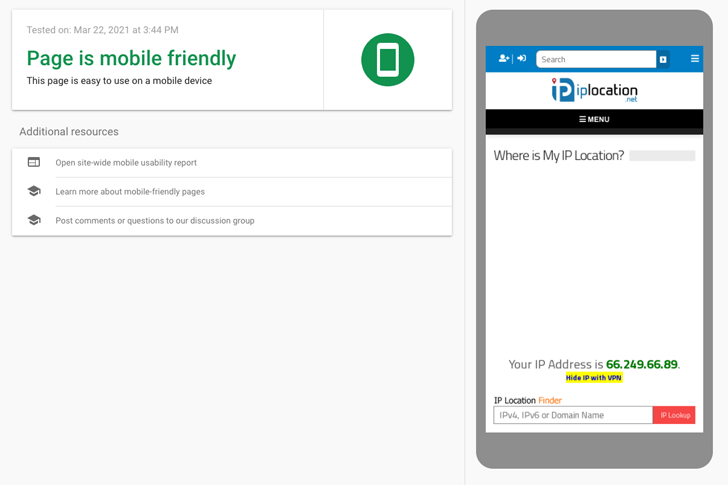
With the transition from desktop-first indexing to mobile-first indexing, it is important to note that the mobile site has the same content as the desktop site. Instead of creating two separate websites (desktop and mobile versions), designing a responsive website that adapts to both environments would be ideal.
What is AMP?
Google introduced the AMP Project to make the mobile web to load instantly. AMP, known as Accelerated Mobile Pages, is a lightweight HTML page that is designed specifically for mobile devices to load faster and more seamlessly. This involves creating a stripped-down version of HTML5 optimized for mobile-only use and keeping the original for desktop. The AMP Project is open-source and maintained by Google, and has many contributors like WordPress, Twitter, Bing, and Stackoverflow.
To make AMP pages load lightning-fast, the framework enforces resource restrictions.
- CSS is limited to 75KB.
- JavaScript is limited to 150KB.
- Remove all render-blocking resources from the webpages.
To load faster, the AMP pages are cached on Google servers for instant display. Google will preload and prerender AMP pages and serve them to the user as search results. This makes it speedy loading of the AMP page if clicked by a user on SERP.
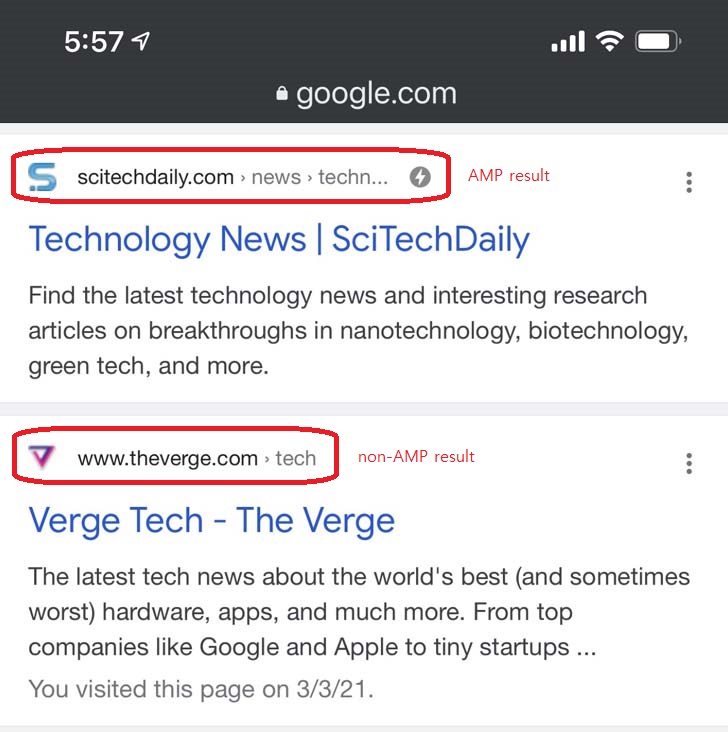
So, how does AMP help with SEO? Using AMP technology alone will not improve SEO; the page speed does. Google emphasizes page speed as a key ranking factor—something every experienced SEO company prioritizes. The average load time on AMP pages is less than a second, which is significantly faster than the 10-second average load time on non-AMP pages.
The downside of using AMP is that it's a scaled-down version of HTML5, and it is a restrictive framework. Also, the webmaster must maintain AMP and non-AMP versions of the webpages, which is a maintenance overhead.
There are several ways in which you can differentiate the AMP pages from non-AMP pages via the URL:
- Using a GET parameter: Add a GET parameter at the end of the URL, i.e.,?amp
- Using a subfolder: Add a folder name in the URL, i.e., https://domain/amp/
- Using a subdomain: Place the AMP pages on a separate subdomain, i.e., https://amp.iplocation.net/
- Appending a name: Add the "amp" string in its filename, i.e., page.amp
The most popular and Google-recommended method is the subfolder option, but you're welcome to use any method.
Conclusion
AMP is a stripped-down version of mobile HTML for mobile devices. The primary goal of using AMP is to speed up mobile pages for instant load times. If you're primarily serving desktop visitors, or your site loads within 2 seconds, you may not realize the benefits of implementing AMP pages. It is also primarily for static pages, not for dynamic pages like shopping carts. Understanding Google's core web vitals, and meeting those metrics will help lead your SEO efforts.
Share this post
Leave a comment
All comments are moderated. Spammy and bot submitted comments are deleted. Please submit the comments that are helpful to others, and we'll approve your comments. A comment that includes outbound link will only be approved if the content is relevant to the topic, and has some value to our readers.
Comments (0)
No comment